

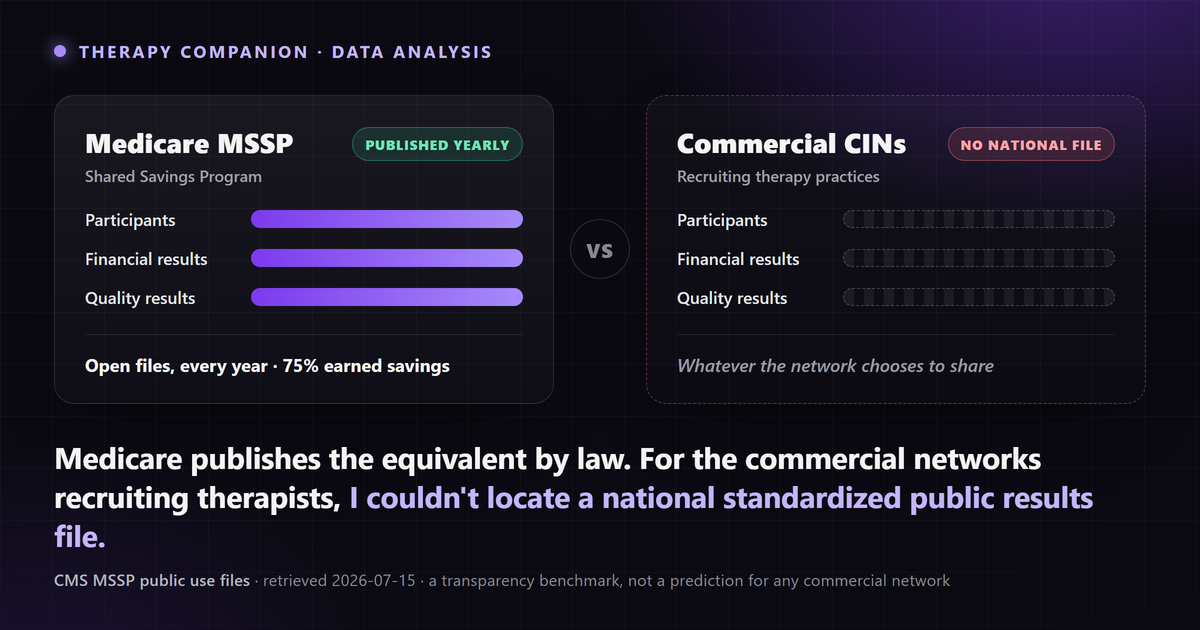
Medicare's Shared Savings Program offers a transparency benchmark, not proof that any commercial network is good or bad.
Clinically integrated networks, CINs, are being pitched to therapy practices right now, and some of them may create real value: better contracts than a solo practice could negotiate, shared infrastructure, referral relationships. I am not writing to argue against joining one. I am writing because an independent practice evaluating one needs enough information to assess the contract economics, the operational obligations, and the risk, and I wanted to see how much of that information is publicly available. Here is what I found.
What a CIN is
A clinically integrated network is a group of independent practices that contracts with commercial insurance payers as one unit. Because joint negotiation among competitors raises antitrust questions, the legal contours come from a small set of Federal Trade Commission staff advisory opinions: MedSouth (2002, follow-up dated June 18, 2007), Suburban Health Organization (dated March 28, 2006), Greater Rochester IPA (dated September 17, 2007), TriState Health Partners (dated April 13, 2009), and Norman PHO (dated February 13, 2013). All are published in the FTC's advisory opinion library (copies retrieved 2026-07-15). The standard quoted in the TriState letter asks whether the network runs "an active and ongoing program to evaluate and modify practice patterns by the network's physician participants and create a high degree of interdependence and cooperation among the physicians to control costs and ensure quality."
Two cautions before anyone treats those letters as a green light. First, each opinion is a fact-specific analysis of one proposal at one moment; none of them is blanket permission for joint negotiation. Second, the FTC formally withdrew its health-care enforcement policy statements in July 2023 (press release), so the underlying guidance landscape has shifted. I am a founder writing about data, not a lawyer; nothing here is legal guidance.
In plain English, though, the model is consistent across those letters: the network negotiates on behalf of its members, and in exchange the members participate in shared protocols, shared metrics, shared technology, and performance measurement. Whether that trade is worth it for a given practice is a numbers question.
The transparency benchmark
Medicare runs a large program built on similar integration logic: the Medicare Shared Savings Program, whose accountable care organizations now include over 15,000 participating organizations. Because it is a federal program, CMS publishes machine-readable files every year: who participates (Accountable Care Organization Participants) and how every ACO performed financially and on quality (Performance Year Financial and Quality Results). I pulled both, retrieved 2026-07-15.
To be precise about what this comparison can and cannot do: MSSP results describe Medicare ACOs. They are not a prediction of how any particular commercial CIN performs, and commercial contracts differ in structure. What the MSSP files provide is a transparency benchmark: they show the kind of reporting that is possible, and they put real numbers on the governance and distribution questions a practice should ask any network. On the commercial side, I found no national, standardized public reporting system comparable to CMS's MSSP participant and annual financial and quality files. Individual commercial CINs may publish information about themselves, and some payers and states disclose pieces, but there is no registry-grade equivalent I could locate. My search method and its limits are in the methodology note below.
What the benchmark shows
Three findings from the CMS files.
First, at the network level the recent results look strong. In performance year 2024, 359 of 476 ACOs, about 75 percent, received a shared savings payment. Total payments were about 4.1 billion dollars. The median earning ACO received about 6.0 million dollars.
Second, scale matters when reading that headline. The median ACO listed 827 participating providers. Across earning ACOs, the median of each ACO's earned savings divided by its listed providers was 6,641 dollars in 2024, down from 8,067 dollars in 2021. That figure is an even-split reference point, not an individual clinician payout: shared savings are paid to the ACO legal entity, and actual distributions are set by each ACO's internal agreement, which may allocate more or less than an even split to any given clinician after the network's own costs. The distribution question is exactly the kind of term a practice should see in writing. The results are also concentrated: the top 10 percent of earning ACOs captured 44.5 percent of all earned savings in 2024.
Third, behavioral health barely appears in the participant lists. The 2026 participants file names 15,276 distinct organizations. Screening those names for behavioral-health terms flags 39 organizations, about 0.3 percent. That is a name screen, not a definitive count: an exact-name check of the 39 against the NPPES registry matched a behavioral-health taxonomy for 14 (name variants prevent clean matching for the rest), the screen can miss behavioral-health organizations with generic names, and the file cannot see behavioral-health clinicians employed inside general medical organizations at all. Even with those limits, the signal is consistent across every year I measured back to 2016: organizations whose name identifies them as behavioral health are a very small share of the one integrated-network model that publishes its participant lists.
Risk, and where it sits
Some CIN and value-based contracts move from fee-for-service toward capitation (a fixed payment per member per month) or add downside risk (sharing losses if spending exceeds a benchmark). Depending on the contract, these arrangements can transfer some utilization risk from the insurer toward the practice, and contracts vary widely in how much protection they include: risk corridors, stop-loss coverage, reserve requirements, and who is liable if the network misses.
The Medicare data shows why this deserves attention: 15 to 20 ACOs per year in 2021 through 2024 generated gross losses relative to their benchmarks. In the CMS files that is a benchmark result, not necessarily money each ACO owed back; repayment depends on the ACO's track. But those are organizations with hundreds of providers and actuarial support, and some of them still ended up on the wrong side of the benchmark. A small practice evaluating a risk-bearing contract should know, in writing, what happens to it in that scenario.
The information gap
Whether a particular network is a good deal is an empirical question. One side of the table typically has claims history, actuarial modeling, and network-level performance data. A practice owner evaluating the pitch has whatever the network chooses to share, because there is no public results file to consult. Every number in this piece exists because federal rules put the Medicare version's data in the open. For a commercial network, the practice has to ask for the equivalent directly, and the questions below are designed for that.
Eight questions to ask before joining any CIN or value-based network
- Who holds the payer contracts, and can I see the actual fee schedule or capitation rate before I sign?
- What did the network pay out to participants last year, and how exactly is the distribution formula written?
- If the contract carries downside risk now or later, what are the risk corridors, stop-loss coverage, and reserve arrangements, and who is legally liable if the network misses its targets?
- What performance data will I get back, how often, and do I keep access to my own data if I leave?
- Who sets the quality measures I will be scored on, and was any behavioral health clinician involved in setting them?
- What does participation cost in fees, required technology, and reporting hours, and what is the realistic per-clinician payout net of those costs?
- What are the exit terms: notice period, patient transition rules, exclusivity clauses, and which payer contracts I lose on the way out?
- Since no national public registry exists for these networks, what audited or third-party evidence of past results can the network show me?
Methodology and caveats
CMS figures were computed from the Medicare Shared Savings Program public use files on data.cms.gov (Performance Year Financial and Quality Results, PY2021 through PY2024, and Accountable Care Organization Participants, PY2016 through PY2026), retrieved 2026-07-15. Per-provider figures divide each ACO's earned savings by its listed provider count (the PUF's physician, NP, PA, and CNS columns) and report the median across earning ACOs. The behavioral-health screen is keyword-based on participant legal business names, verified where possible against the NPPES registry; the keyword list and validation results are in the project repository. The statement that no comparable national reporting system exists for commercial CINs reflects a search of federal and state data catalogs and industry sources conducted in July 2026; it is a statement about what I could locate, not a certified legal survey. FTC materials cited: the advisory opinion library and the July 2023 press release on withdrawal of the health-care enforcement policy statements. None of this is legal or financial advice.