Your software knows everything
If you're a therapist in private practice, your software knows everything: your client diagnoses, session notes, treatment plans, insurance claims, billing history, and appointment patterns. It's the most intimate data in healthcare.
So here's a question most therapists never think to ask: who actually owns the company behind that software?
I spent weeks researching the ownership structures behind every major therapy platform. I looked at SEC filings, Crunchbase funding records, PitchBook data, and company press releases.
Every single one has private equity, insurance company, or payer-aligned financial ties.
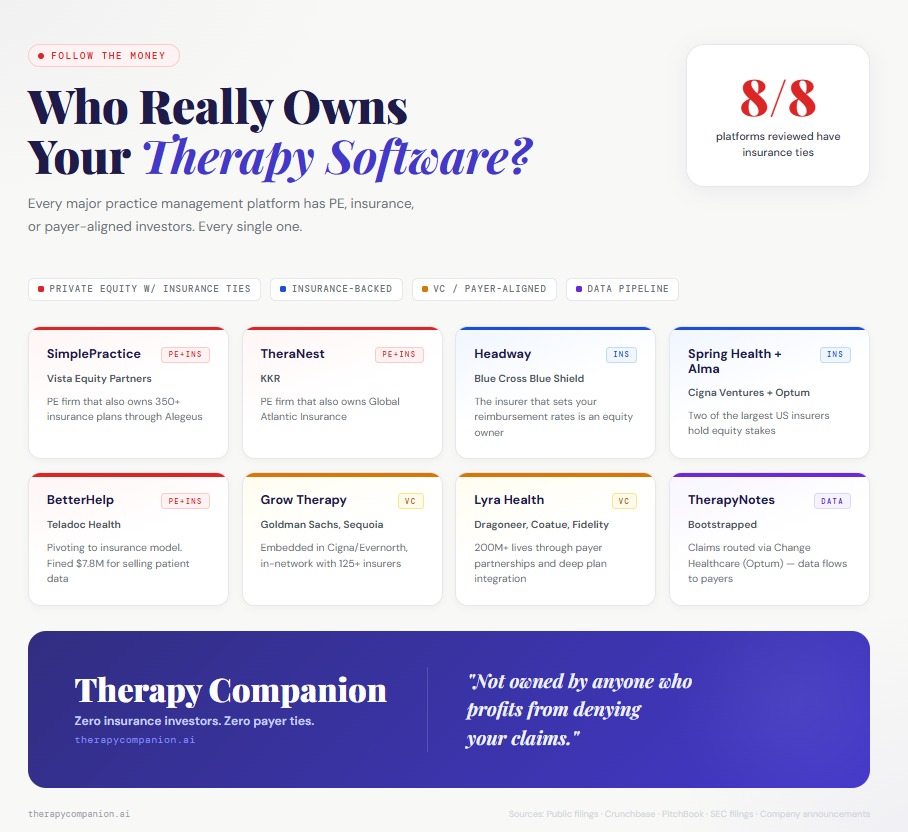
Here are the 8 I dug deepest into — followed by a full table of all 15 platforms I reviewed.
SimplePractice: Vista Equity Partners
SimplePractice is the most widely used practice management platform for therapists, with over 225,000 users. In January 2024, Vista Equity Partners completed a $4 billion acquisition of EngageSmart — the parent company that owns SimplePractice.
Vista isn't just any PE firm. From 2018 until July 2026 they also owned Alegeus, a healthcare benefits administration platform serving over 350 health plan clients, 225,000 employers and 30 million consumers. Then they sold it to Optum. So the infrastructure that processes benefit payments for hundreds of insurance plans now sits inside UnitedHealth Group, while the software therapists use to document sessions stays with the private equity firm that sold it there.
TheraNest (now Ensora Mental Health): KKR
In May 2021, KKR acquired Therapy Brands — the parent company of TheraNest — for $1.25 billion. Therapy Brands also owns ShareNote, AccuPoint, Procentive, and several other behavioral health software products, serving over 200,000 individual providers across 28,000 practices.
KKR fully owns Global Atlantic, one of the largest insurance and reinsurance companies in the United States. KKR acquired the remaining 37% of Global Atlantic in January 2024, bringing their ownership to 100%.
Since the acquisition, user reports consistently describe engineering resources redirected from product improvement to platform consolidation, support quality degradation, and business practices that prioritize margin extraction over customer experience. In April 2025, Therapy Brands rebranded to Ensora Health — but the ownership hasn't changed.
Headway: Blue Cross Blue Shield
Headway has raised approximately $326 million in total funding. The company's Series C round was strategically backed by Health Care Service Corporation (HCSC), the largest customer-owned health insurer in the United States and an independent licensee of the Blue Cross and Blue Shield Association.
This isn't a passive financial investment. HCSC took a lead position in the strategic investments portion of the funding round specifically to "further improve access to quality behavioral health services" — through the platform it now has equity in.
Headway has since expanded partnerships with Cigna, Blue Cross Blue Shield of Massachusetts, and Blue Cross NC, embedding itself as an insurer-backed intermediary between therapists and payers.
Spring Health + Alma: Cigna Ventures + Optum
In early 2026, Spring Health acquired Alma in one of the largest pure-play mental health acquisitions in recent years. Spring Health has raised $470 million to date at a $3.3 billion valuation.
But here's the part that matters for therapists: Alma's $130 million Series D round was backed directly by Cigna's venture arm and Optum Ventures — the investment arm of UnitedHealth Group, the largest health insurer in the United States. Two of the three biggest insurance companies in America hold equity stakes in the platform that handles therapist credentialing, billing, and insurance claims.
Alma charges therapists a monthly membership fee of roughly $125 plus a percentage of insurance reimbursements. The companies setting your reimbursement rates are invested in the platform collecting a cut of those same reimbursements.
BetterHelp: Teladoc Health
BetterHelp is owned by Teladoc Health and contributed over $1 billion in revenue in 2022 — nearly half of Teladoc's entire top line.
In 2023, the Federal Trade Commission fined BetterHelp $7.8 million and banned them from sharing consumer health data for advertising purposes. The FTC found that BetterHelp had shared clients' email addresses, IP addresses, and health questionnaire information with Facebook, Snapchat, Criteo, and Pinterest for advertising — despite explicitly promising users that their data would remain private.
The FTC called it the first action returning funds directly to consumers whose health data was compromised. BetterHelp had been monetizing therapy clients' sensitive mental health information from 2013 to 2020.
Teladoc is now pivoting BetterHelp toward an insurance-reimbursement model, further entangling the platform with payer interests.
Grow Therapy: Goldman Sachs, Sequoia
Grow Therapy has raised $328 million in total funding, including a $150 million Series D in March 2026 backed by Goldman Sachs Alternatives, TCV, Sequoia, and others. The company reached $1 billion in revenue in 2025.
Grow Therapy is embedded in the insurance system by design. Their network covers over 220 million Americans through deals with 125+ health plans, including Humana, Cigna, UnitedHealthcare, and Aetna. They've expanded into Medicare and Medicaid.
This isn't a practice management tool that happens to support insurance billing. It's a payer-aligned marketplace that connects therapists to insurer networks — and the therapists are locked into the platform's terms. Grow Therapy's business model depends on maintaining and deepening relationships with the insurance companies that control reimbursement.
Lyra Health: Dragoneer, Coatue, Fidelity
Lyra Health has raised over $900 million in venture funding, including a $235 million round led by Dragoneer and a $200 million round led by Coatue. Their investors also include Salesforce Ventures and Fidelity.
Lyra serves more than 20 million people globally through direct employer contracts and has pathways for over 200 million people to access care through partners and health plans. Their model is deeply integrated with payer systems — employers and health plans pay Lyra, and Lyra contracts with therapists.
This creates a fundamental incentive misalignment: Lyra's customers are the employers and insurers paying for care, not the therapists delivering it. When cost containment matters more than clinical outcomes, the platform's loyalties are clear.
TherapyNotes: Bootstrapped, and it moved its data off Optum
TherapyNotes is the one platform on this list that hasn't taken outside investment. It was bootstrapped and remains independently owned. Credit where it's due.
For years its claims ran through Change Healthcare, the dominant clearinghouse in the United States, which Optum acquired for $13 billion in a deal that closed in October 2022. That put the largest health insurer in the country in the middle of a system processing roughly 15 billion healthcare transactions per year.
Then in February 2024 a cyberattack shut Change Healthcare down, and claims across the industry stopped moving. TherapyNotes migrated its claims and remittance processing to CLAIM.MD, a privately held, founder-owned clearinghouse with no insurer or private equity parent. That is where it remains.
It is worth naming what that took, because most platforms did not do it. It is also worth naming who is left holding the pipes.
The consolidator to actually watch is Optum
Follow the ownership long enough and the same name keeps appearing. Optum owns Change Healthcare, the clearinghouse most therapy claims have passed through. In July 2026 it bought Alegeus, the benefits platform behind hundreds of health plans. Optum Ventures put money into Alma, the network that takes a cut of therapists' reimbursements. And Optum is part of UnitedHealth Group, which is also paying those claims.
None of that is illegal, and none of it requires bad intent to matter. It means the company setting your reimbursement rate may also own the pipe your claim travels through, the platform administering the patient's benefit, and a stake in the network you joined to get paid faster.
The full picture: all 15 platforms reviewed
The 8 platforms above got the deepest investigation. But I researched 7 more — and the pattern holds across every one.
| Platform | Category | Owners / Investors | Connection |
|---|---|---|---|
| SimplePractice | PE + Insurance | Vista Equity Partners | Also owns Alegeus (350+ insurance plan clients) |
| TheraNest (Ensora) | PE + Insurance | KKR | Also owns Global Atlantic Insurance (100%) |
| Headway | Insurance-Backed | HCSC (Blue Cross Blue Shield) | Insurer that sets reimbursement rates is an equity owner |
| Spring Health + Alma | Insurance-Backed | Cigna Ventures + Optum Ventures | Two of the three largest US insurers hold equity |
| BetterHelp | PE / Payer-Aligned | Teladoc Health | Fined $7.8M by FTC for selling patient data; pivoting to insurance model |
| Grow Therapy | VC / Payer-Aligned | Goldman Sachs, Sequoia, TCV | In-network with 125+ insurers, covers 220M Americans |
| Lyra Health | VC / Payer-Aligned | Dragoneer, Coatue, Fidelity | 200M+ lives through payer partnerships |
| TherapyNotes | Data Pipeline | Bootstrapped | Claims routed through Change Healthcare (Optum) — 15B txns/year |
| Talkspace | Payer-Aligned | Public (NASDAQ: TALK) | Payor revenue up 54% YoY; in-network in 45 states |
| Cerebral | VC-Backed | SoftBank ($300M Series C) | $4.8B valuation; DOJ investigation for prescribing practices |
| Rula | Insurance-Backed | Blue Venture Fund (BCBS), Sequoia | Backed by a fund created by multiple BCBS plans |
| SonderMind | VC-Backed | General Catalyst, Drive Capital | $1.57B valuation; 12K contracted providers across 50 states |
| Practice Fusion | DOJ Settlement | Allscripts (acquired $100M) | $145M DOJ settlement for opioid kickback scheme |
| Jane App | VC-Backed | Frontier Growth, JMI Equity | $16.9M raised; PE-backed growth investors |
| Practice Better | VC-Backed | Five Elms Capital | $41.2M raised; PE-led growth investment |
15 out of 15 platforms reviewed have outside financial ties — whether private equity ownership, insurance company investment, venture capital with payer alignment, or data infrastructure controlled by insurers.
Why this matters for therapists
This isn't about conspiracy theories. Every one of these facts is public record — press releases, SEC filings, Crunchbase profiles, and FTC enforcement actions.
The question is simple: when an insurance company invests in the software you use to document sessions and submit claims, whose interests is that software optimized for?
The incentive problem
Insurance companies profit from denying or reducing claims. If they own equity in the software generating those claims, there's a structural conflict of interest — even if no one is actively exploiting it today.
Private equity firms optimize for returns, not clinical outcomes. The KKR/Therapy Brands playbook is well-documented: acquire, consolidate, cut costs, extract margins. Therapists are the product, not the customer.
Payer-aligned platforms prioritize insurer relationships over therapist autonomy. When your platform's revenue depends on maintaining contracts with Cigna and UnitedHealthcare, therapist advocacy takes a back seat.
Data flows create invisible leverage. Even bootstrapped platforms route claims through Optum-owned infrastructure, giving the largest insurer in America visibility into the billing patterns of hundreds of thousands of therapists.
The denial crisis
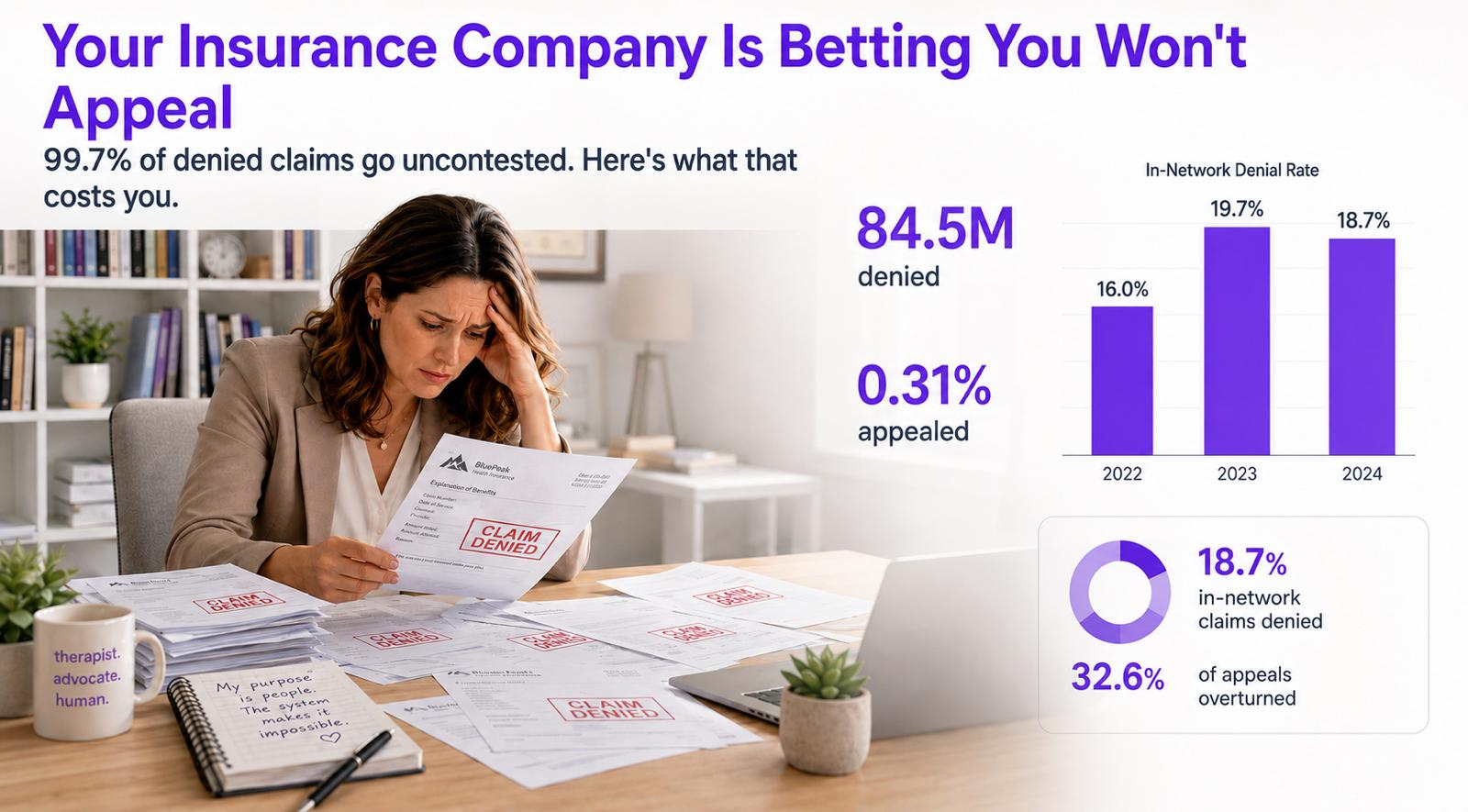
Mental health claims are already denied 85% more often than medical claims (APA, 2024). Only 11.5% of denials are appealed — but 81.7% of those appeals succeed. The system is designed to discourage therapists from fighting back. The last thing therapists need is for their own software to be part of that system.
What the alternative looks like
I built Therapy Companion as a solo founder with zero private equity money, zero insurance company investors, and zero payer-aligned venture capital.
That's not an accident. It's the whole point.
When no insurance company has equity in my platform, I can build features that actually protect therapists — like AI-optimized documentation that ensures notes meet medical necessity standards, reducing the denial rate. I don't have to worry about whether that feature inconveniences a payer who also happens to be my investor.
When no PE firm is extracting margins, I can invest in support, keep pricing fair, and make product decisions based on what therapists need — not what drives quarterly returns.
Your practice management software sees everything: every diagnosis, every session note, every claim, every dollar. It should work for you. Not for the insurance company.
Sources: Vista Equity Partners press releases · KKR press releases · Global Atlantic Financial Group · HCSC newsroom · Becker's Payer Issues · Fierce Healthcare · FTC.gov · Grow Therapy blog · Lyra Health press releases · Healthcare IT News · ProPublica · APA 2024 Mental Health Parity Report